


The Scenario
You’ve booked your flights, and they were a bargain compared to how much you paid for your Phuket trip last February. You got a great deal on a fantastic hotel, right in the most happening part of Kata. Your excitement is mounting with every passing day. With your October trip just weeks away, you’ve already decided which excursions you want to plan, which dive sites you want to revisit, which new ones you’re keen to try out, and which delicious Thai dishes you’re going to seek out as soon as you land. Close your eyes for a moment, and you can almost feel the sun on your skin and hear the waves lapping gently at the shore while you sip your Leo watching the sunset from Kata beach. Bliss.
Then, one slow afternoon at work, you idly check the weather forecast. You thought you’d be feeding your anticipation of paradise, but the hues dramatically darken on your dreams; all the colour drains out of them, as if The Grim Reaper has stepped into their path and their blood runs cold:
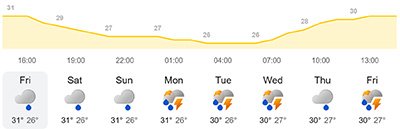
All you see is rainclouds, rain, and lightning for the foreseeable future. The temperature looks great, but how can it possibly rain EVERY DAY?
What have you done?
You look for reassurance, “It’s okay, I’ll ask a question on the Facebook group I’ve been following.” The replies pour in and you eagerly open up every single one, as soon as it’s posted. After twenty comments that “you should know better than to book a trip in August”, a few “if you don’t like rain, stay at home”, some dubious offers to meet up, and endless adverts for local tours, you turn off commenting and retreat into your own misery.
Don’t Despair
Here’s how it is. Those rainclouds, with all the thunder and lightning all over the forecast might never materialise. Relax. The chances are that it will rain on many days, but not all day. Most of the time rain showers are very localised; it can be hammering down at one end of Kata beach while the other end remains dry and sunny. It’s common for it to rain at night while you’re tucked up in your four-star-at-a-two-star-priced-hotel bed. And it’s a rare event – very rare – that it will rain constantly for two weeks solid: it’s not completely impossible, but it’s highly unlikely that it will happen to you.
How Does the Weather Affect Phuket Scuba Diving in General?
If you’re diving, you need to be wary of the wind more than the rain. Sure, it’s much brighter and prettier underwater if it’s sunny up above, but if it’s a little gloomy the diving can still be wonderful. Sometimes it can even enhance the experience: nocturnal predators sometimes start their evening hunts early if the light has faded; shy creatures that usually hang out in dark hidey-holes might be brave enough to venture out if they think dusk is already falling.
If the surface is choppy though, depending on the dive site and the wind direction, you could have a much different experience. The longer and harder the wind blows, the bigger the waves become. Big waves can rule out some dive sites completely if they’re exposed, or make the trip there and back particularly rough, even for divers with sturdy sea legs.
Luckily, the wind direction is very much predictable, depending on which month you’re here. Check out our infographic below for an overview of how we can generally predict the wind direction.
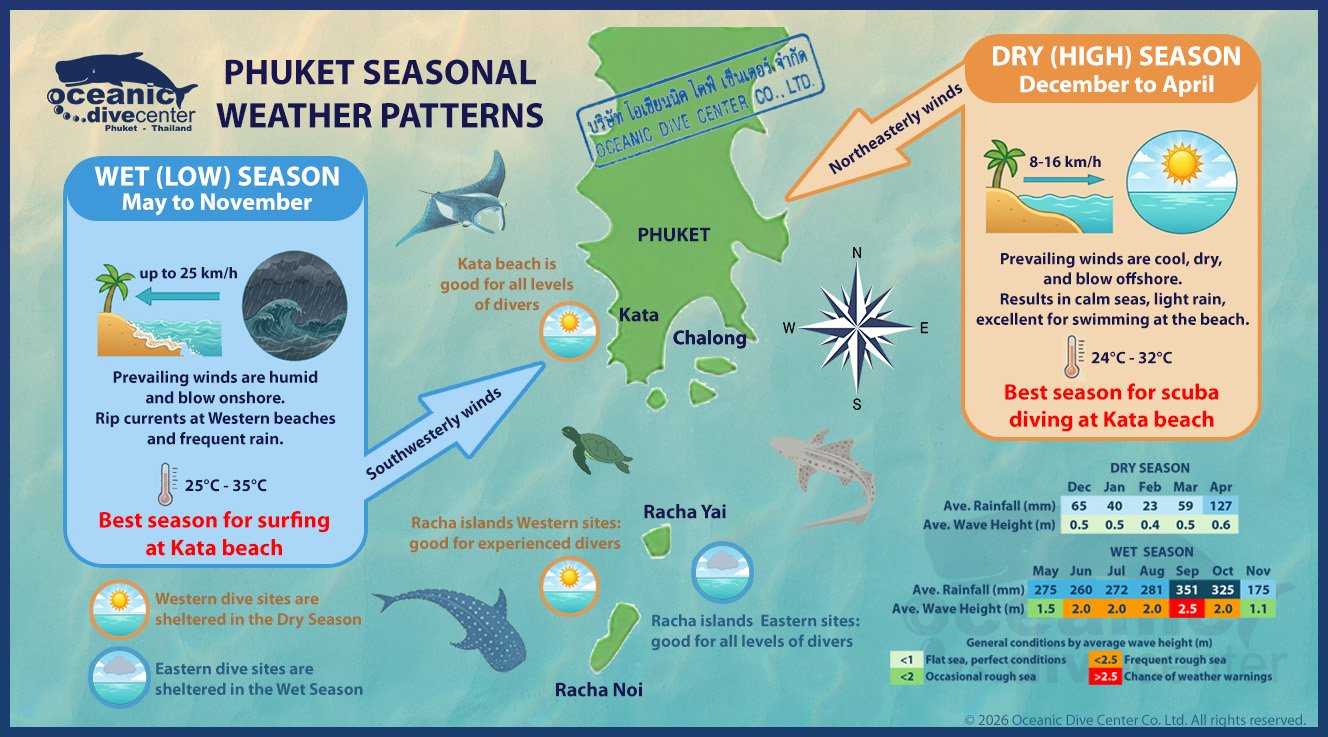
Wind strength is a different issue. We have detailed maritime forecasts that give us a good idea of what to expect, and those forecasts can be surprisingly accurate. Unfortunately, they can also be entirely wrong, but we’ve developed an instinct of when that’s likely to be the case.
Phuket Dive Sites and How They’re Affected by Big Waves
- King Cruiser wreck and Shark Point. These sites are completely exposed so it’s not safe to dive there with big waves at any time of year. If medium to strong winds are predicted, we generally advise against planning to dive there because if the waves pick up the night before a trip, or on the morning of a trip, the boat captain might make the decision it’s not safe to go there, so you’ll end up doing different, inferior dive sites.
- Kata Beach. West-facing Kata beach is reliably sheltered during the dry (high) season and reliably rough during the wet (low) season. During the wet season, even if we have a few days of no wind, and the sea looks flat from the beach, the visibility will usually still be poor and there’s likely to be surge. Add to that there’s always a chance of an unexpected rainstorm the night before your planned dive and the run-off from Kata’s roads will reduce the visibility dramatically. This is why Kata beach is usually a poor choice during the wet season.
- Racha Yai and Racha Noi. This is where things get a little less black and white. The Eastern coasts of both islands are generally sheltered during our Wet season. That’s where the best dive sites for beginners are found. The calm bays with big areas of sand on the East coasts of both islands make it easy for first time scuba divers and Open Water students to practice skills. During Dry season, when we find shelter from the waves on the West coast, the dive sites at Racha Noi make skills practice difficult for novice divers, but experienced divers will love the massive boulder formations reminiscent of the Similan islands. Racha Yai’s West coast really only has one dive site, so it gets dangerously crowded during our dry, high season and, while the diving can be nice, it won’t beat Kata beach at that time of year.
- Phi Phi. Since the trip to Phi Phi is at least two and a half hours long, just for that alone we avoid it if there’s any chance of waves. But Wet season waves are the worst because the best dive sites are on the Western sides of the islands. If you’re not diving the best dive sites at Phi Phi, the visibility is poor, strong currents have restricted your dive plan, and you’ve endured nearly 5 hours’ round trip, it can be a real let down. These factors regularly come together during our wet season, and we will always give honest advice about the likely conditions.
How to Make the Most Out of a Low Season Holiday for Scuba or Snorkeling
When it comes to questions about Phuket’s weather, there’s never a simple answer. Some dive sites are better in low season, some are not. If you’re coming here in low season and planning any activities on the water, keep as flexible as possible about which dates you choose. In any two week period, dry season or wet season, it’s vanishingly rare that every single day will be bad weather for diving. But if you sit on the beach for the first week of your vacation, and then book your scuba trip as an afterthought a few days before your flight home, there’s a good chance you’ll be disappointed. Given around ten days’ notice of your arrival and departure dates we can usually set up at least one or two days good diving for you.
We will never send you out on a boat without giving you advance notice of how the weather is likely to turn out. If we’re cancelling trips or warning you of bad weather, it’s only for your safety and comfort.
Please feel welcome to contact us for more information: WhatsApp or info@oceanicdivecenter.com